Music education · 2027
Music Education Abroad in 2027
How to turn talent into a profession
A complete guide to contemporary music degrees, practice-led study in London, portfolios, admissions, English requirements, costs, visa restrictions and career pathways.
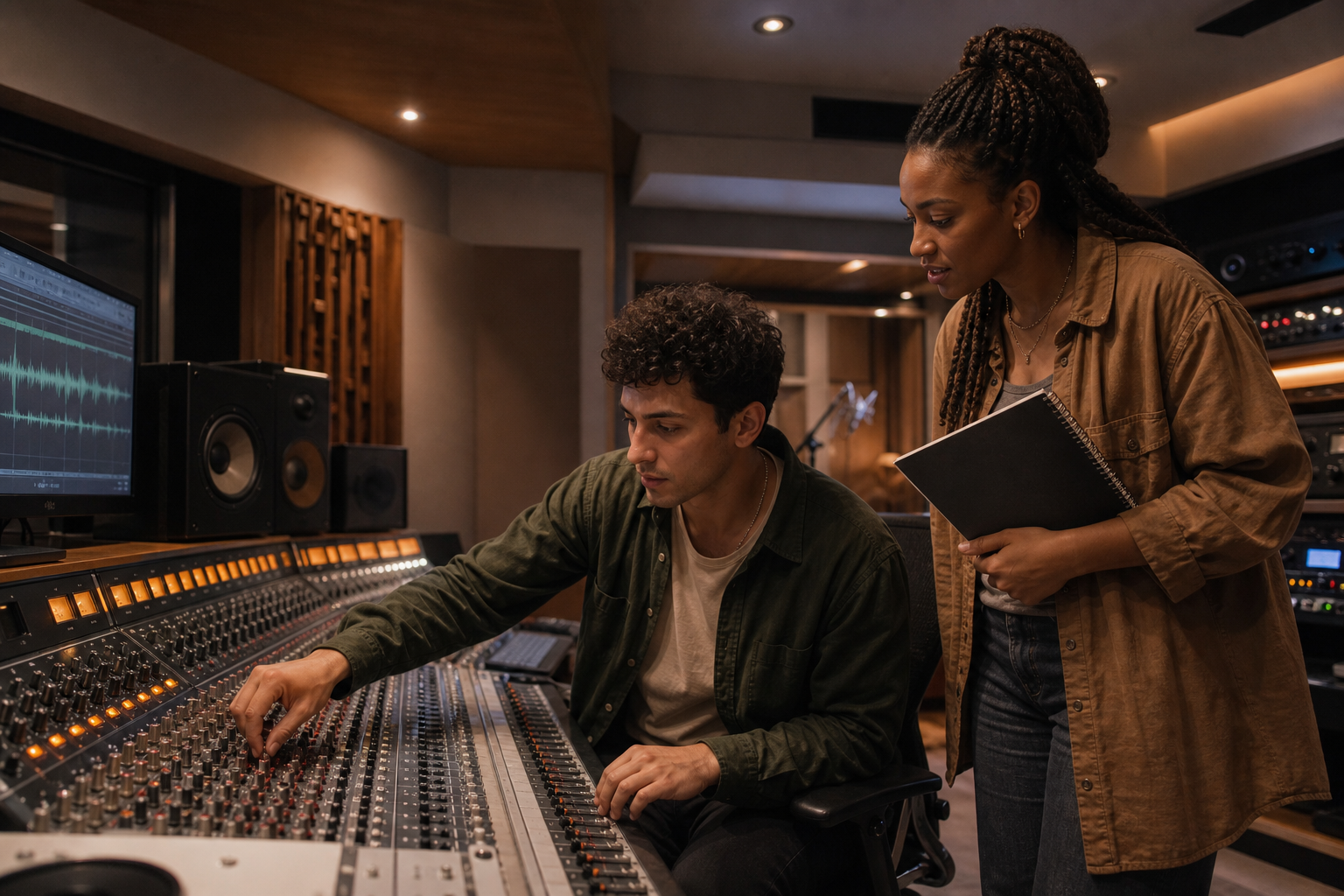

Studying music abroad is worthwhile not because a degree automatically makes someone an artist, but because a strong programme turns an interest in music into a coherent set of professional skills: creating and recording tracks, working with sound, performing, writing songs, understanding the music business, building a portfolio and making industry connections. The best place to study music abroad is not necessarily the “most famous school”, but a programme where you make work every week, receive thoughtful feedback and gradually establish your own professional direction.
GUGA Education helps candidates make that choice without trawling through dozens of courses at random: deciding whether music production, sound engineering, DJing and live performance, vocals, songwriting, music business or audio programming is the right path; checking admissions requirements; and planning the portfolio, documents, English, budget and visa timeline. We do not promise an instant career or guaranteed admission. We work with each candidate to build a strong, realistic route.
The short answer. Studying music abroad makes sense if you want to do more than “be creative”: you want to master a specific role in today’s music industry, are prepared to practise extensively, can respond to professional criticism and are willing to develop creative, technical and entrepreneurial skills at the same time.
Why music today is far more than a performing career
The question “what can I do after a music degree?” often begins on stage: singer, instrumentalist or DJ. In reality, a single release can involve dozens of roles. A songwriter creates the song, a producer shapes its sound, a recording engineer runs the session, a mix engineer builds the balance, a mastering engineer prepares the final version, a manager coordinates the strategy, an artist and repertoire specialist (A&R) develops new talent, a music licensing specialist works with film and advertising, and an audio developer creates digital instruments and effects.
The scale of the industry confirms that this is not a niche hobby. According to IFPI, global recorded-music revenue reached US$31.7 billion in 2025, the eleventh consecutive year of growth. Streaming generated 69.6% of revenue, while the number of paid subscription accounts worldwide reached 837 million. In the United Kingdom, the music industry generated £8 billion in gross value added and £4.8 billion in export revenue in 2024, while supporting approximately 220,000 full-time-equivalent jobs.
Large market figures, however, do not translate into an easy income for every musician. UK Music’s analysis shows that, among people who earned all their income from music, 43% made less than £14,000 a year. A serious music education should therefore teach more than creativity: it should cover client work, rights, budgets, deadlines, professional presentation and the development of several income streams.
Why being a musician can be exhilarating — and why that is not enough to choose a programme
A career in music offers a rare combination of creative freedom and technical precision. An idea can become a track, a live show, a soundtrack, a podcast, audio for a game or a new software instrument. You can collaborate across countries, work in a studio, on stage or for a media company, or build a career that combines several fields.
Yet the romantic idea that “I love music, so any music programme will suit me” almost always leads to a weak decision. You need to understand which part of the process gives you the most energy:
- developing the harmony, melody and form of a song;
- building a track in a digital audio workstation;
- recording voices and instruments;
- finding the character of a sound and creating a mix;
- performing for an audience;
- developing an artist, release or music brand;
- creating sound for film, games, advertising and podcasts;
- programming synthesisers, audio plug-ins and interactive systems.
The right education should strengthen the way you think rather than force every student down the same path.
How to choose a music specialism: today’s routes abroad
Music production
Music production is for people who want to guide a track from its first idea to its final sound. You will work with arrangement, rhythm, synthesis, samples, recording, editing, mixing and creative direction. A producer does not simply “press buttons”: they decide what the listener should hear and why.
Sound engineering and audio engineering
Sound engineering focuses more closely on the quality of recording and playback: acoustics, microphones, signal routing, studio consoles, editing, mixing and mastering. Compare the actual studio modules and access to practical work, not just the wording on the degree certificate. This route suits people who enjoy combining a trained ear, technology and precise organisation. It can lead to studio work, live sound, post-production, film, television or studio management.
DJing and electronic music
DJing involves much more than transitions between tracks. Check whether a programme covers music selection, set construction, reading a crowd, club culture, creating original material, performance preparation, promotion and professional ethics. For a lasting career, it is especially valuable when DJ study connects with production rather than stopping at equipment operation.
Vocal performance and songwriting
A vocal programme should develop technique, interpretation, stamina on stage, microphone work and studio recording. Songwriting adds form, lyrics, melody, harmony, co-writing and an understanding of what happens to a work after it is finished. Programmes that combine vocal performance with original work often require an audition, so admissions preparation needs to begin earlier.
Music business
Music business is suited to people who want to work with artists and catalogues without necessarily performing themselves. Programmes may cover A&R, artist management, publishing, copyright and related rights, licensing music for film, advertising and other media, the live sector, marketing, public relations, streaming analytics and campaign launches.
Radio, podcasts and audio content
This route brings together voice, narrative, recording, editing, editorial work and distribution. It is relevant for people drawn to broadcasting, audio documentary, branded podcasts, audio news or the production of spoken-word content.
Music technology and audio programming
If music and code interest you equally, consider programmes that combine production, digital signal processing, C++ or other programming languages, plug-in development, interactive audio and sound for games. Music-software engineering forms a bridge between the creative industries and the technology sector.
From song to profession: how the contemporary music process works
A strong programme presents the whole workflow rather than a collection of isolated subjects:
- Write. Develop the idea, melody, lyrics, harmony, rhythm and dramatic arc.
- Record. Prepare the session, choose microphones, set levels, organise performers and capture high-quality material.
- Mix. Build space, balance, dynamics and character so that every decision supports the creative intention.
- Release. Prepare the final master, metadata, rights, visual story, communications and promotion plan.
This connection between creativity, technology and the market is what separates professional training from a random collection of short lessons.
Self-teaching or a structured programme: what each route offers
Many future producers begin with video tutorials, home practice and independent releases. Self-teaching develops initiative and can produce a strong portfolio. A structured programme becomes particularly useful when a student needs equipment, a team, continuity and an external view of the gaps: poor acoustics, a disorganised workflow, technical errors, repetitive arrangements, too few completed projects or limited understanding of rights and the market.
The advantage of structured education is not access to “secret information”. Its value lies in regular practice, professional feedback, more demanding projects, real equipment, collaboration and deadlines. A degree does not replace a portfolio, but a good programme creates the conditions in which that portfolio can become stronger and more varied.
Why the United Kingdom and London attract aspiring music professionals
Studying music in the UK provides access to a broad ecosystem: recording, live music, festivals, publishers, management, media, advertising, film, games and technology companies. When candidates consider where to study music abroad, London often makes the shortlist because it brings many of these fields together in one city. Students see not only a curriculum, but also how different professions interact in practice.
London is also expensive and highly competitive. Its cultural reputation alone is not a sufficient reason to choose it. Compare the programme, genuine access to studios, the amount of practical work, teaching staff, portfolio opportunities, course length, the full cost of living and Student visa rules.
For more on the country and its education system, read GUGA’s guide to studying in the United Kingdom.
Point Blank Music School as an example of practice-led music education in London
Point Blank Music School is a specialist higher-education provider in music and a GUGA Education partner. Its London programmes are built around contemporary industry practice: studio work, production, sound engineering, DJing, vocal performance, songwriting, music business, podcasting and music software.
When planning an application to Point Blank Music School, GUGA first matches the subject route to the candidate’s experience and goals, and only then moves to the documents. That order matters: a London music school may offer many appealing routes, but only the one aligned with your future role has real value.
The important question is not how much equipment appears in a photograph, but what a candidate will do with it every week. When comparing options, GUGA checks whether a programme contains a logical sequence of practical modules, completed individual and group projects, feedback, studio access, a connection to the professional music industry and clear learning outcomes.
In the 2023 Teaching Excellence Framework, Point Blank Limited received an overall Gold rating, Gold for student experience and Silver for student outcomes. This is a useful independent indicator, but it does not replace a personal review of the specific programme, its format and its fit with an applicant’s goals.
Tuition fees and general academic and English-language requirements were checked against the provider’s current pages on 19 August 2026. The range of subjects was cross-checked against the 2026–2027 partner prospectus, and the start dates below are examples from individually verified programmes. Before an application is submitted, GUGA checks the terms again for the chosen course and the candidate’s nationality.
Music programmes in the UK: routes to consider
Available routes include bachelor’s degrees in music production and sound engineering in the UK, accelerated programmes, one-year higher-education certificates and a foundation year. The table below is not a ranking. It is a map of options to compare with your own goals.
| Route | What you study | Who it may suit |
|---|---|---|
| Music production and sound engineering | production, composition, sound design, recording, mixing, mastering, audio for media, marketing and entrepreneurship | aspiring producers, sound engineers and electronic-music artists |
| Music production, DJing and live performance | track creation, DJ technique, set construction, performance and artist branding | students who want to combine studio and stage |
| Music production and vocal performance | vocal technique, studio recording, stagecraft and production | vocalists who want greater control over their sound |
| Music production and songwriting | songwriting, arrangement, co-writing, production and portfolio development | songwriters and artists |
| Vocal performance and songwriting | vocals, stage interpretation, original songwriting and recording | performers prepared for an audition |
| Music business | A&R, management, rights, publishing, licensing, marketing and campaigns | future managers, marketers and music entrepreneurs |
| Radio, audio and podcasting | recording, editing, audio storytelling, production and distribution | people who want to work with voice and editorial audio |
| Music production and software engineering | audio production, programming, digital signal processing, plug-ins and interactive audio | candidates working at the intersection of music, mathematics and technology |
Course length varies by programme. Bachelor’s routes usually take three years, while some are available in an accelerated two-year format. A Certificate of Higher Education can take one year, and a foundation year can support candidates who do not yet have the formal qualifications or experience for direct entry. Start dates also differ: selected programmes offer October 2026, January or April 2027 and October 2027, but this is not a universal calendar for every course.
Who this model of education may suit
A practice-led music school can be a strong choice if you:
- want to create finished work rather than study only history or theory;
- are prepared to share unfinished material regularly and respond to criticism;
- are interested in contemporary genres, studio technology or music business;
- want to build a portfolio while you study;
- understand that a career also requires discipline, communication and self-promotion;
- are ready to collaborate with vocalists, producers, engineers and managers.
It may be a poor fit for a candidate seeking predominantly classical conservatoire training, someone unwilling to work with technology or anyone expecting admission itself to deliver popularity and a high income.
Applying for a music degree: what admissions teams assess
Requirements depend on the level and subject. For bachelor’s programmes in London, 112 points on the UK’s UCAS Tariff is a typical reference point, or an equivalent international qualification. Admissions teams assess more than formal education: they consider readiness for a practical programme, motivation, experience, creative work, understanding of the field and English.
For applicants from Ukraine, the Certificate of Complete General Secondary Education on its own is considered for a bachelor’s degree with a foundation year. For direct entry, the provider specifies the certificate together with a one-year UK foundation programme at a recognised institution or one successfully completed year at a university. Each application is ultimately assessed on its own merits. The bachelor’s route in software engineering also requires mathematics at UK GCSE grade 4/C or an equivalent level; the foundation year is not currently a pathway into this programme.
An application may require:
- a school certificate or degree and academic transcript;
- certified translations of documents;
- a motivation letter or personal statement;
- an academic or professional reference;
- examples of music work or a portfolio;
- evidence of English proficiency;
- passport and financial documents;
- an audition for vocal programmes;
- an interview or additional creative task if required by the course.
For an organisational checklist, see GUGA’s guide to documents for applying abroad. To present a convincing case, use our guide to the motivation letter for an international university.
A portfolio for music production, vocals or songwriting
A portfolio for a music application should demonstrate not only taste, but also the ability to complete work. Even when it is not a formal requirement, a selection helps candidates assess their own level and explain their motivation more precisely. Do not try to impress an admissions team with quantity. Three or four finished pieces with a clear account of your role are stronger than a folder of unrelated drafts.
For production, you might prepare:
- two or three contrasting tracks;
- a brief explanation of the idea, arrangement and tools;
- a “before” and “after” version if you want to demonstrate mixing or editing;
- an account of exactly what you did if the project was collaborative;
- notes on a problem you had to solve.
For vocals, accuracy, musicianship, control, interpretation and material suited to your range all matter. In songwriting, the strength of the melody, lyrics, structure and original creative choices matters. Do not disguise weak work with excessive effects, and never claim another person’s contribution to a collaborative project as your own.
GUGA can audit a portfolio, help select and sequence the strongest work, formulate an honest description of the candidate’s role and create a plan for what should still be finished before submission. We do not create the work on a student’s behalf: the portfolio must represent their genuine voice and current level.
English for music education in the United Kingdom
For many of the programmes discussed, a typical requirement is IELTS Academic 6.0 overall with at least 5.5 in each component. Other tests or previous qualifications may also be accepted, but an exemption from a language test should never be assumed. For one certificate course, an applicant who needs a Student visa may be required to take an approved Secure English Language Test (SELT).
Music students need more than “everyday English”. They will have to explain creative decisions, work from technical instructions, give feedback, present projects, arrange sessions and write academic assignments. Preparation should therefore include the professional vocabulary used in real music-making contexts.
The cost of studying music in the UK and the budget you really need
For international applicants, tuition for the 2026/27 academic year depends on the format. At the time of checking, standard bachelor’s programmes and most certificates cost £15,750 per year, an accelerated two-year bachelor’s format cost £16,500 per year, the one-year certificate in radio, audio and podcasting cost £9,000, and a foundation year cost £15,750. International candidates must also pay a non-refundable £100 application-processing fee; if the application is successful, it is deducted from tuition.
This is not the full budget. Add:
- accommodation and a rental deposit;
- food and transport;
- the visa fee and immigration health surcharge;
- travel and initial expenses after arrival;
- a laptop, storage, headphones or other necessary tools;
- equipment insurance;
- a contingency reserve.
Some eligible EU students may have access to a scholarship mechanism that reduces tuition to the Home-student rate, but eligibility and conditions must be confirmed individually. Do not build a financial plan around a scholarship until you have written confirmation.
Compare more than the annual fee. Calculate the full cost of the route: the number of years, living expenses, possible breaks, equipment, deposits and a reserve. For broader planning, read GUGA’s guide to affordable places to study abroad.
The Student visa and working as a musician: an important restriction
One of the most dangerous assumptions is that a student in the UK can earn unrestricted income from performances, sell services independently or start a business. The current Student visa rules generally prohibit self-employment and business activity, as well as working as an entertainer. Assessed work experience is permitted only when it is an integral part of the course and meets separate requirements; it is not a general permission to undertake paid performances.
Do not count future fees from concerts, DJ sets, production or freelance work as guaranteed funds in a student budget. Before undertaking any paid activity, check the visa conditions and the provider’s rules, and seek regulated immigration advice where necessary. GUGA helps coordinate the educational documents and timeline, but does not replace an authorised immigration adviser.
The basic route is explained in our guide to the Student visa for studying abroad.
Careers after music education: where graduates work
Music-industry professions rarely exist in isolation, so a degree can lead to a family of related roles rather than a single job:
| Strength | Possible roles | What an employer or client needs to see |
|---|---|---|
| Track creation | music producer, beatmaker, arranger, songwriter | finished releases, a range of genres and a clear personal contribution |
| Sound | recording engineer, mix engineer, studio assistant, live sound engineer | recording quality, technical process, reliability and a trained ear |
| Vocals and songwriting | vocalist, songwriter, session performer, writer for other artists | video and audio performances, a catalogue of songs and the ability to collaborate |
| Business | A&R assistant, artist manager, release coordinator, rights or marketing specialist | campaign case studies, audience analysis, knowledge of rights and communication |
| Audio content | podcast producer, audio editor, radio producer, media sound engineer | strong episodes, editing, narrative and clean sound |
| Technology | audio plug-in developer, audio programmer, game sound designer, interactive-audio specialist | code, working prototypes, an understanding of digital signal processing and a musical ear |
Employers and clients assess more than a degree. They look at the portfolio, the ability to complete projects, technical reliability, communication, references and professional conduct. For more on moving from study into a career, read GUGA’s guide to working after studying abroad.
How to compare two music programmes
Do not choose a programme on the basis of a short promotional video or a list of famous alumni. Ask both providers the same questions:
| Criterion | What to check |
|---|---|
| Learning outcome | which completed pieces will be in your portfolio after each year |
| Practical work | how many hours of studio access are available and how equipment is booked |
| Teaching staff | whether they currently work in the relevant part of the industry |
| Feedback | who assesses the work, how often and against which criteria |
| Collaborative projects | whether producers, vocalists, writers and business students work together |
| Career preparation | whether the programme covers rights, contracts, presentation, budgeting and promotion |
| City | whether the city’s opportunities justify its full cost of living |
| Admissions | whether the course requires a portfolio, audition, interview or separate language test |
| Visa | whether the programme’s format and length fit the required immigration route |
| Full cost | tuition, living costs, equipment, fees, relocation and contingency reserve |
GUGA creates this kind of comparison for an individual candidate, not for an abstract ranking. It reveals where a programme genuinely fits the goal and where an attractive name may conceal weak practical value.
Application plan for a music programme starting in 2027
9–12 months before: define the direction and budget
Assess your strengths, experience and gaps. Choose two or three realistic directions, compare programme length and full costs, check your passport and begin planning your English preparation.
6–9 months before: assemble an initial portfolio
Finish several contrasting pieces, seek professional feedback, document your role in collaborative projects and prepare audition material if it is required.
4–6 months before: prepare the documents
Order transcripts and translations, develop the motivation letter, arrange a reference, take the language test and check the technical requirements for audio, video or links to work.
2–4 months before: apply and prepare for selection
Check every field in the application, pay only officially confirmed fees and prepare to explain your work and creative decisions. Do not wait until the final day: large audio and video files create additional technical risk.
After an offer: verify the terms before paying
Check the programme, length, start date, tuition, deposit, refund terms, academic conditions, visa documents and budget for the first months. Do not make a decision simply because one offer arrived first.
How GUGA Education supports an application for a music programme
GUGA begins with the candidate’s profile, not a generic course list. We help to:
- define the professional direction and programme level;
- identify relevant programmes and verify current requirements;
- build a timeline for admissions, English, the portfolio and finances;
- audit creative work and the explanation of the candidate’s contribution;
- prepare a motivation letter without templates or invented achievements;
- organise documents, translations, references and submission;
- prepare for an audition or interview;
- compare offers and written financial terms;
- coordinate the educational part of the visa process and preparation for relocation.
Explore study programmes abroad or book an admissions consultation for a route designed around your level, direction and budget.
Frequently asked questions about studying music abroad
Do I need formal music-school training to apply?
Not for every contemporary music programme. Production, music business, DJing and audio technology may assess practical experience and motivation more broadly than formal classical training. The exact requirements depend on the course.
Can I apply without a portfolio?
For some programmes, yes, if a portfolio is not listed as a formal requirement. Even so, several completed pieces can demonstrate interest, help you prepare for an interview and show whether a practice-led format suits you.
How do I know which creative or technical route suits me?
If ideas, arrangement and the character of a track excite you most, look towards production. If you are drawn to recording, acoustics, technical quality, balance and playback, consider sound engineering. The fields overlap on many programmes, so compare modules and projects rather than the title alone.
Do I need to play an instrument?
It is useful, but not always a formal requirement. Performance ability is crucial for vocal or performance programmes; music business or audio programming may place greater weight on different competencies.
What level of English do I need to study music in the UK?
For the programmes discussed, a typical reference point is IELTS Academic 6.0 overall with 5.5 in each component, but accepted tests and exemptions are checked separately. A SELT may be required for certain visa routes.
How much does music education in London cost?
For the 2026/27 academic year, the international fees reviewed ranged from £9,000 for one specific one-year certificate to £16,500 per year for an accelerated bachelor’s format. Budget separately for living costs, visa expenses, relocation and equipment.
Can I work as a DJ or musician while studying?
Do not assume that this is automatically permitted. The Student visa generally prohibits self-employment, business activity and working as an entertainer. Every paid activity must be checked against the current rules and the conditions attached to the visa.
Is an audition required?
Yes for vocal and some performance programmes. Production, business or audio-technology courses may use a different selection process: a portfolio, motivation letter, interview or evidence of previous education.
Does a music degree guarantee employment?
No. A degree can provide structure, practice, equipment, feedback and connections, but a career depends on the portfolio, quality of work, professional conduct, network and ability to find opportunities.
What careers are available if I do not become an artist?
Music education can lead to production, studio and live sound, podcasting, management, A&R, marketing, rights, licensing music for film, advertising and other media, sound design, audio programming, and sound for film or games.
Is an accelerated two-year bachelor’s degree worth considering?
It shortens the overall duration but has a more intensive pace and a higher annual fee. Compare the full cost of two and three years, workload, time for portfolio development, visa eligibility and your personal readiness.
When should I start preparing for a 2027 intake?
Ideally, begin 9–12 months in advance. If you need to improve your English, prepare an audition or create new portfolio work, an early start substantially reduces the risk of a rushed and weak application.
Conclusion: a music career begins with a precise choice of role
The strongest reason to study music abroad is not the dream of “becoming famous”, but the opportunity to work every day like a future professional: writing, recording, mixing, performing, analysing the market, protecting rights, building a portfolio and taking a project through to release. When a programme fits your direction and the application is planned honestly and systematically, talent gains an environment in which it can become professional capability.
GUGA Education can help define the route, verify the programme, prepare the creative and documentary elements and guide the entire application process without formulaic promises. Book an admissions consultation to begin with an analysis of your experience, work and goals.
Sources and data currency
Tuition fees and general academic and English-language requirements were checked on 19 August 2026 against the provider’s current materials. The range of subjects was cross-checked against the 2026–2027 partner prospectus, while start dates are included only as examples from individually verified programmes. Market data comes from the IFPI Global Music Report 2026 and UK Music; the independent quality assessment is from the 2023 Teaching Excellence Framework; career descriptions are from the National Careers Service; and visa restrictions are from the current Immigration Rules Appendix Student. Conditions can change, so GUGA checks them again for the specific programme and candidate before submission.