Choosing an audio course · 2027
Music Production, Sound Engineering or Audio Engineering in 2027
How to choose a course that matches the way you think
A complete guide to professional roles, course modules, studio practice, portfolios, admissions, fees, visas, careers and choosing the right route.
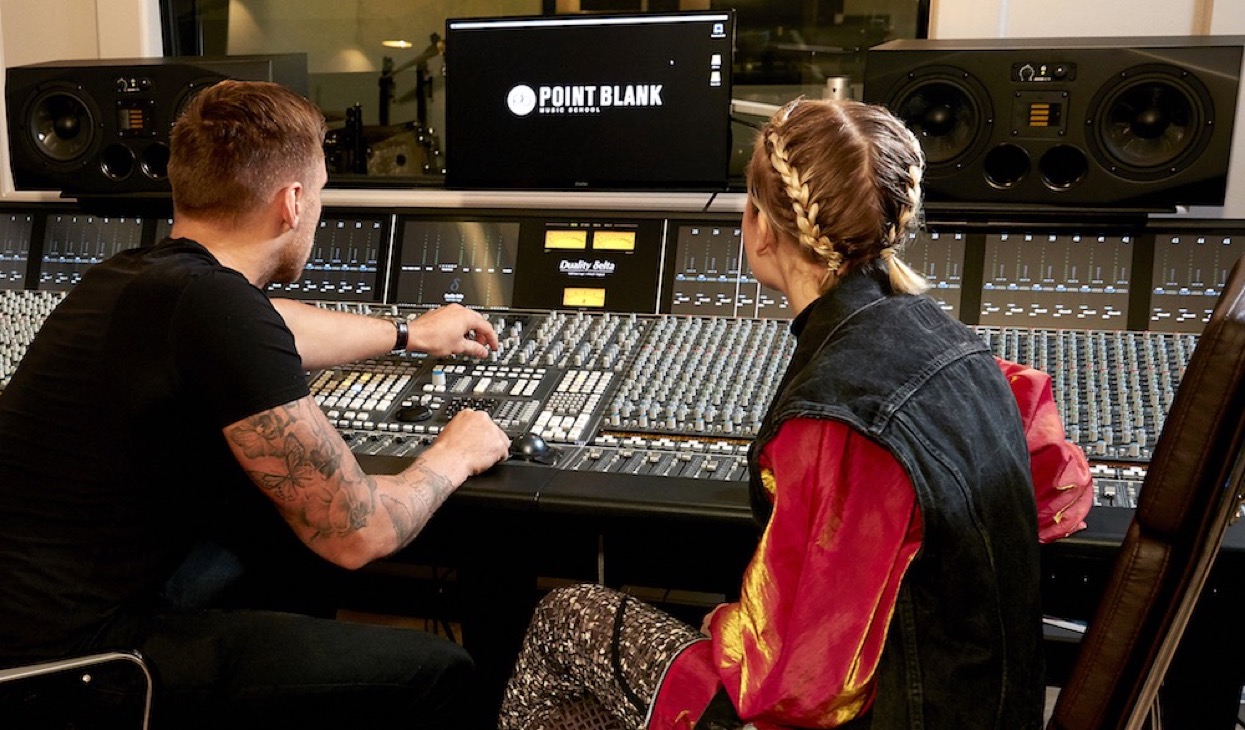




The terms music production, sound engineering and audio engineering often appear side by side in course listings, yet they can lead to very different academic priorities. A future producer might spend hours searching for the right rhythm, harmony and development of a track. A studio engineer may be thinking about microphones, acoustics, signal level, phase, routing and recording quality. An audio professional might not work with songs at all, but with concerts, film, games, podcasts, broadcasts or spatial sound.
The dividing line is not always visible in the degree title. One course with “production” in its name may include substantial recording and mixing; another may be built almost entirely around composition, beatmaking and an original creative project. That is why applicants should look beyond the words on the prospectus and examine the modules, studio hours, feedback system, portfolio outcomes and professional role the course is designed to support.
GUGA Education turns that decision into a set of testable criteria. We help candidates compare their creative and technical strengths, assess music production and sound engineering courses abroad, verify current entry requirements, and plan a portfolio, English preparation, budget and application. We do not replace a serious choice with an attractive course title. The aim is to find a programme that genuinely reflects the work the student wants to do.
The short answer. Choose music production if you are most excited by ideas, composition, arrangement, an artist’s sound and turning a track into a coherent whole. Choose sound engineering or audio engineering if you enjoy precise recording, acoustics, signal flow, equipment, mixing, technical problem-solving and reliable processes. If both sides matter equally, look for a genuinely hybrid course—but judge it by its assignments, projects and studio access, not by the title alone.
Music production or sound engineering: the short answer
Ask yourself four questions before opening a ranking or browsing campus photographs:
- What do I want to create? Songs and original releases; high-quality recordings for other artists; live sound; or audio for film, games, advertising and podcasts.
- Which decisions absorb me? Melody, rhythm, arrangement and emotion—or microphones, acoustics, levels, routing, editing and accuracy.
- Which responsibility am I ready to carry? The creative integrity of a project, the technical reliability of a session, or both.
- What should my portfolio prove? An individual voice and finished tracks; recording and mixing quality; dependable live work; or an ability to work across different media.
If you constantly rewrite choruses, change the groove and think about how the music should unfold, production is likely to suit you. If you want to know why a vocal sounds harsh, how to remove noise without stripping away character, where to place a microphone or why a mix collapses on another playback system, sound engineering may be the stronger fit. If you care equally about the content and the way it is technically realised, a hybrid route can be powerful—provided it offers real depth rather than a superficial tour of everything.
Why music production, sound engineering and audio engineering are so often confused
In a modern home studio, one person may create the beat, record the vocal, edit takes, mix and prepare a release. The professional boundaries can therefore look unnecessary. On a more complex project, however, they become crucial: the producer is responsible for what should be created, while the engineer is responsible for how it can be recorded, processed, reproduced or delivered accurately and reliably.
Terminology also changes between countries and working environments. In the UK, “sound engineer” may refer to a studio or live-sound professional. “Audio engineer” is often used as a broader term covering recording, mixing, live sound, broadcast, post-production and other fields. In other languages, the closest local term may combine a technical role with creative responsibility for the dramatic shape of sound.
The word “engineering” can also mislead applicants. Some audio engineering degrees are practical creative-technical courses in studio sound. Others move much closer to electronics, programming, digital signal processing, acoustics and mathematics. Expectations formed from one course title should never be applied to every course carrying the same label.
Producer, sound engineer and audio engineer: the roles without the marketing fog
Music producer
Shapes the creative framework of a recording: the idea, composition, form, arrangement, performance, timbre and overall emotional logic. A producer may programme parts and have strong technical skills, but the central question is: “What should this piece become, and which choices will make it convincing?”
Studio engineer or recording engineer
Prepares and runs the recording, chooses and positions microphones, configures the signal path, controls levels, listens for noise and distortion, organises the session, edits material and delivers technically dependable tracks. The work is creative, but that creativity rests on precision, acoustics and a repeatable process.
Mixing engineer
Turns a collection of tracks into a coherent mix. They balance level, frequency, dynamics and space, direct the listener’s attention and test whether the recording translates across playback systems. Strong mixing does more than “make the vocal louder”; it reveals the composition through sound.
Mastering engineer
Works with the final mix, or a sequence of mixes, to maintain the technical and tonal consistency of a release, prepare the required versions and identify problems that may have gone unnoticed. Mastering is a distinct specialism, not a button that automatically makes a track louder.
Live sound engineer
Designs and configures the system for a venue, runs soundcheck, operates the console during a performance, manages monitoring, microphones, cables and safety, and reacts quickly to unpredictable changes. A technical error happens in front of an audience, so composure and discipline are essential.
Audio engineer as a broad professional category
May work in studio recording, concerts, television, film, games, podcasts, broadcasting, audiovisual systems, spatial audio or technology. Research and software routes can demand substantially more mathematics, physics and coding than a typical creative course.
How the roles work together from demo to release
Consider a vocal-led song. The producer and artist define the emotional centre, structure, tempo and character of the arrangement. The recording engineer prepares the room, microphone, preamp, headphone mix and session so the performer can deliver a strong take. A vocal producer works on phrasing and delivery. An editor selects the best parts of the takes and cleans the material. The mixing engineer builds balance, space and dynamics. The mastering engineer checks final coherence and prepares the release formats.
On a small project, one person may perform every function. That does not erase the distinction between them; it makes the ability to switch roles even more important. If you are judging the artist’s emotion, watching for signal overload and anticipating the mix at the same time, each decision still needs to answer a clear purpose.
For an applicant, this map is more useful than the prestige of a job title. It shows where in the process you want to exert the greatest influence and where you are willing to be accountable for the result.
Music production vs sound engineering: the main differences at a glance
| Criterion | Music production | Sound engineering / audio engineering |
|---|---|---|
| Central question | what should the music become | how can the sound work accurately, expressively and reliably |
| Main focus | song, artist, arrangement, style, release | signal, acoustics, equipment, recording, mixing, reproduction |
| Typical tools | digital audio workstation (DAW), MIDI controllers, samples, synthesisers, composition and production methods | microphones, consoles, patchbays, monitoring, measurement, DAW, sound-reinforcement systems |
| Strong portfolio evidence | finished tracks and a clearly explained creative contribution | recording and mix comparisons, technical notes, varied sessions and environments |
| Core way of thinking | “which decision will strengthen the piece?” | “what is happening to the signal, and how do I secure the required result?” |
| People involved | artist, songwriter, performers, label, creative team | artist, producer, technical team, director, organiser, venue |
| Typical risks | endless drafts, weak composition, copying trends | technical failure, poor session organisation, weak diagnosis |
| Career settings | artist releases, personal projects, music for media, advertising | studios, concerts, film and TV, podcasts, broadcast, games, installations |
| When it may not suit you | if uncertainty and subjective creative work exhaust you | if accuracy, repeatable process, equipment and technical responsibility do not interest you |
Neither column is “more creative” or “more serious”. A good engineer makes creative decisions, and a good producer understands technical constraints. The difference is the centre of gravity.
Choose by the way you think, not by a fashionable course title
You are probably closer to music production if you:
- constantly notice song form, groove, melody and arrangement;
- want to create your own tracks or develop an artist’s sound;
- can propose several creative options and tolerate an ambiguous answer;
- are willing to rewrite material repeatedly in search of a stronger emotion;
- want to combine music, technology, communication and an understanding of the industry.
You are probably closer to sound engineering or audio engineering if you:
- hear noise, phase problems, imbalance or harshness and want to find the cause;
- enjoy configuring systems, documenting work and building a dependable workflow;
- maintain concentration under pressure and troubleshoot technical faults quickly;
- are interested in acoustics, microphones, electronics, signal and measurement;
- want to apply audio skills beyond music—in concerts, film, games, podcasts or broadcasting.
If both lists describe you, there is no need to abandon half of your interests. Find a course whose hybrid character is demonstrated through real modules and projects.
What a strong music production degree should teach
Music production is not a course in a single piece of music software. Good education develops the ability to create a finished work under different conditions.
Musicianship and composition
Critical listening, rhythm, harmony, form, melody, arrangement, dramatic development and the ability to explain why a choice works. Not every producer must be a virtuoso performer, but every producer should hear structure and understand the language musicians use.
Working in a digital audio workstation
Recording, MIDI, editing, routing, automation, sampling, synthesis, version control and preparing material for collaboration. The goal is not to collect a list of applications, but to realise an idea fluently in at least one system.
Sound design and producer thinking
Creating timbres, shaping texture, space and dynamics, and turning a reference into an original solution. Sound design should serve the composition rather than conceal its weaknesses.
Working with an artist
Session preparation, communication, creative criticism, ethics, performance work and respect for artistic identity. A producer should not make every artist sound like the producer.
Industry, rights and release
Songwriting splits, master rights, samples, credits, metadata, basic contracts, pitching, marketing and entrepreneurial thinking. A track that cannot be released legally or credited correctly is not a finished professional outcome.
Essential skills for a sound engineer or audio engineer
Signal and levels
Understanding the path from a sound source to a recording or playback system: gain, headroom, noise, distortion, digital and analogue connections, synchronisation and safe routing.
Microphones and acoustics
Polar patterns, sensitivity, proximity effect, positioning, interaction between multiple microphones, early reflections, resonances, isolation and room behaviour. Expensive equipment cannot compensate for poor placement.
Recording, editing, mixing and mastering
Session organisation, comping takes, clean-up, balance, equalisation, dynamics processing, space, automation, translation checks and delivery of technical versions. The engineer must hear not only the effect but also the consequence.
Live sound and systems thinking
Soundcheck, console operation, monitor paths, wireless systems, networked audio, stage plans, safety, backup scenarios and rapid troubleshooting. Live sound rewards preparation and punishes disorder.
Documentation and reliability
File naming, input lists, patching diagrams, session logs, backups, technical riders and handing a project to another specialist. A dependable engineer creates not only sound but a process that can be checked and repeated.
Do you need music school, physics or mathematics?
Formal classical training is not always required for creative music production. Rhythm, harmony, form, listening skills and basic keyboard fluency can nevertheless accelerate the work considerably. Not attending music school does not close the route, but the gaps will need to be addressed through systematic practice.
Studio sound engineering requires applied physics of sound: frequency, wavelength, amplitude, phase, sound-pressure level, reflection and absorption. Many practical courses teach these ideas through studio tasks rather than an abstract university physics course.
For more technical audio engineering, electronics, digital signal processing or music-software development, mathematics and programming may be central. Check whether the programme leads towards creative-technical audio work or engineering development. The same title can conceal very different levels of computation.
How to read a curriculum without being sold a list of fashionable terms
List every compulsory module and place it in one of six categories:
| Category | What to look for in the description |
|---|---|
| Music creation | composition, arrangement, production styles, creative project, work with an artist |
| Audio technique | recording, acoustics, microphones, signal routing, studio practice, live sound |
| Post-production | editing, mixing, mastering, audio for media, games and spatial formats |
| Professional practice | team sessions, real briefs, portfolio, external client, presentation |
| Industry | rights, business, marketing, entrepreneurship, releases, contracts and metadata |
| Academic depth | research, critical listening, analysis, technical documentation, final project |
Then ask uncomfortable questions. How many pieces will you finish? Who will assess them? How many students share one console? Can you book studios outside class? How much individual feedback is provided? Who owns the rights to student projects? What exactly can a graduate show to an employer or client?
Names such as Logic, Ableton, Pro Tools, SSL, Dante or Dolby Atmos in promotional copy do not prove teaching quality. What matters is how many decisions the student makes independently and how demanding a project they can complete.
When a hybrid Music Production & Sound Engineering course is the right choice
A hybrid bachelor’s degree is particularly relevant if you want to create and record music independently, work with other artists, understand mixing and retain a wider choice of entry-level roles. Early in a career, the market often expects people to do more than one thing: prepare a session, record vocals, edit material, create an arrangement and hand over a project without technical disorder.
Breadth has a cost. If a course tries to cover production, DJing, vocals, live sound, film, games, business and programming without enough practical hours, a graduate may remain a beginner in every area. A strong hybrid course first establishes the fundamentals, then allows deeper specialisation through optional modules, a final project and the portfolio.
The decisive test is simple: after reading the curriculum, you should be able to name three to five specific works you could show after graduation. If the answer remains abstract, the marketing is ahead of the substance.
Self-study, a short course, CertHE or a bachelor’s degree?
CertHE means Certificate of Higher Education, a UK qualification equivalent to the first year of higher education. Depending on the programme rules, it may stand alone or form the first stage of further study.
| Format | What it provides | Main risk | Best suited to |
|---|---|---|---|
| Self-study | flexibility, low initial cost, control of pace | uneven gaps, weak critique, no complex team sessions | disciplined creators with mentors and access to practice |
| Short course | rapid focus on a DAW, recording, mixing or live sound | narrow scope and inflated expectations of a career outcome | people who already understand one specific gap |
| CertHE or one-year route | structured fundamentals and a way to test the direction | less time for a deep portfolio and professional network | applicants needing a concentrated academic start |
| Two-year accelerated bachelor’s | a full degree on a denser timetable | high workload and less time for parallel projects | mature, disciplined students with a clear goal |
| Three-year bachelor’s | progression, studios, teamwork, broader portfolio and academic development | higher total cost and poor return if the course is badly chosen | those wanting to build creative and technical foundations systematically |
No format is automatically superior. Compare the amount of high-quality practice, access to equipment, project complexity, individual feedback and a realistic workload—not duration alone.
Building a portfolio for production, sound engineering and audio engineering
A portfolio should demonstrate not only the result but your role in achieving it. An admissions team or employer should not have to guess whether you wrote the track, recorded the vocal, mixed it or simply happened to be in the room.
For music production
- three to five finished and contrasting tracks;
- a concise explanation of the concept, your contribution and key choices;
- one example showing the development from demo to final arrangement;
- a collaborative project that demonstrates work with an artist;
- an honest account of samples, co-writing and substantial use of generative tools.
For studio sound engineering
- recordings of different sources: voice, acoustic and electric instruments, ensemble;
- short before-and-after excerpts from editing or mixing;
- microphone diagrams, selection rationale and session notes;
- an example of an organised multitrack project;
- an explanation of a problem you identified and solved.
For live or media audio
- a technical plan, input list or system diagram;
- a recording or video excerpt of work in a real environment;
- an example of planning a backup scenario;
- sound for a short scene, game, podcast or broadcast;
- a reflection on what worked, what did not and how you would change the process.
GUGA can help organise a creative selection, verify the requirements of a particular course and edit the description of an applicant’s role. We do not invent work or conceal another person’s contribution.
What equipment does a beginner really need?
To begin music production, a reliable computer, one DAW, good headphones, a backup system and, where useful, a small MIDI keyboard are enough. An audio interface and microphone become necessary when you record live material regularly. Monitors make sense only with an understanding of the room and the ability to listen at moderate levels.
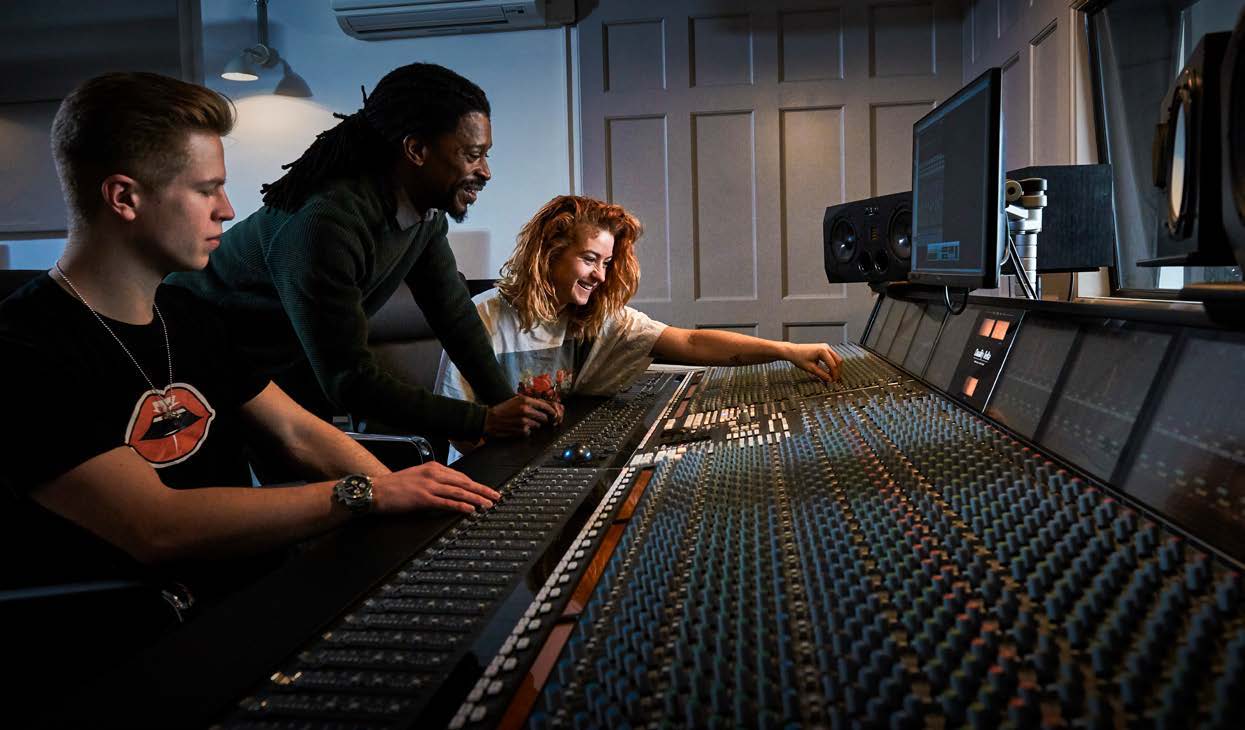
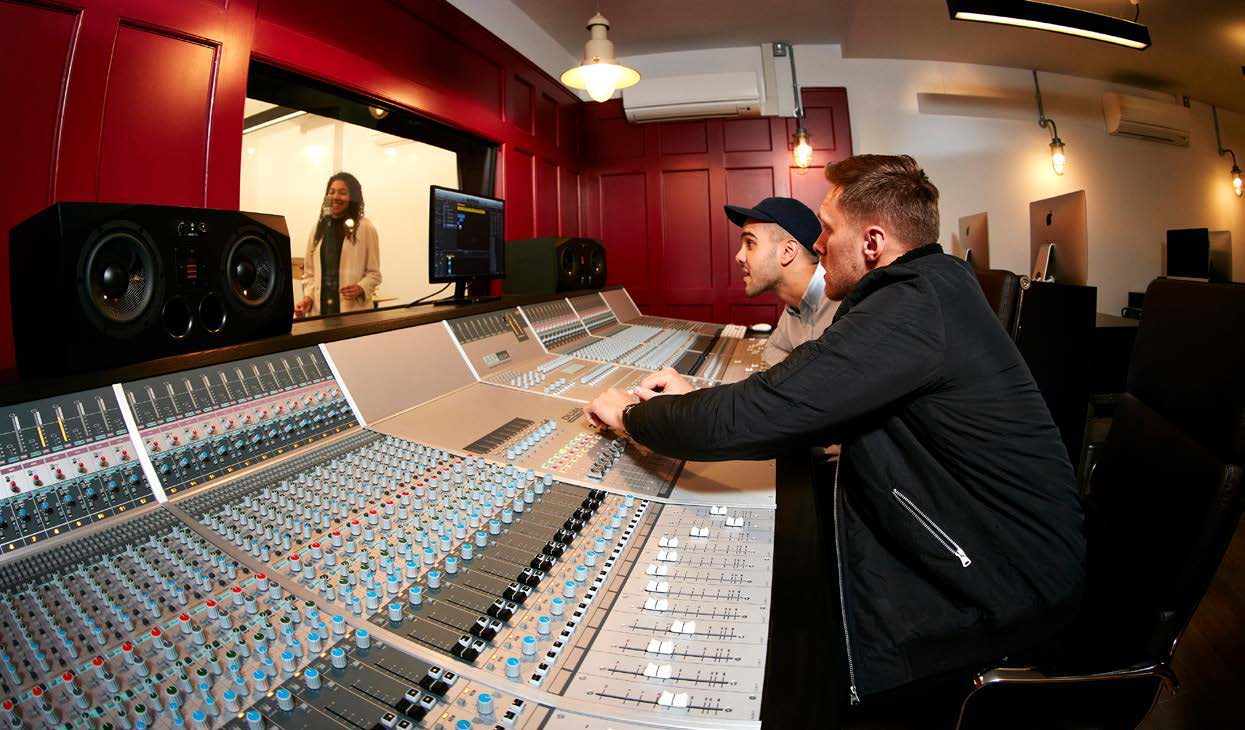
A future sound engineer needs experience with varied equipment, but buying everything for home is irrational. The value of an educational environment lies precisely in access to consoles, microphones, studios, monitoring systems and stage equipment, alongside supervised safe practice. A modest personal setup supports regular work; a professional inventory exists for more complex tasks.
The worst investment is an expensive purchase without finished projects. The best is a tool that removes a specific limitation and is used every week.
Why the UK and London attract aspiring producers and engineers
The UK brings together studio culture, a live sector, broadcasting, film, advertising, games, podcasts, technology companies and specialist music education. For a student, that does not guarantee a career; it creates a dense environment in which one skill can apply across several industries.
London is particularly valuable for the variety of teams. A producer can work with vocalists, songwriters, DJs, musicians and business specialists; an engineer can move between studio, live and media projects. Yet the city is expensive, competition is intense, and geography alone does not create a portfolio. A course must provide meaningful access to practice and people, and the budget must cover the full period of study.
Do not stop at the search phrase “sound engineering courses in London”. Check the academic level, type of qualification, timetable, studio hours, booking rights, visa suitability and total cost.
Point Blank Music School as a partner example of hybrid training
Point Blank Music School is a specialist music education provider and a GUGA Education partner. Its London BA (Hons) Music Production & Sound Engineering combines music production, composition, sound design, the music industry, sound engineering, mixing, mastering, music for media and games, marketing, entrepreneurship and a professional portfolio.
This route does not force applicants to pretend that they are already narrow specialists before they apply. Instead, it lets them test themselves in creative and technical roles and then deepen a direction through projects. That can be valuable for a candidate who makes music at home but has not yet had systematic studio experience.
In the 2023 Teaching Excellence Framework, the Office for Students awarded Point Blank Limited Gold overall, Gold for student experience and Silver for student outcomes. This is an independent provider-level indicator, but it does not replace a personal assessment of the specific course, budget, format and fit with the candidate’s goals.
GUGA does not place a direct link to the partner institution in this article. We first assess the candidate’s profile, the current course version and the conditions, then organise the application through our support so that a student does not choose a course by its name alone.
Entry requirements, start dates and fees for the 2026–27 academic year
As of 20 August 2026, the typical academic offer for the three-year London BA (Hons) Music Production & Sound Engineering was listed as 112 UCAS points, BBC at A level or equivalent qualifications. The course entry-requirements page did not identify a separate audition as compulsory. International qualifications are assessed in context, so a Ukrainian school certificate or degree should be reviewed individually rather than converted into British grades without guidance.
The three-year route carries UCAS code WW33 and the two-year accelerated route W3W3. The current course page listed starts on 5 October 2026 and 11 January, 12 April and 4 October 2027. A start date is not an application deadline: international applicants need time for a decision, payment, documents and the visa process.
International fees for 2026/27 were listed as £15,750 per year for the three-year course and £16,500 per year for the two-year accelerated route. These are tuition fees, not the entire budget. Accommodation, transport, food, immigration charges, health-related costs, the deposit, equipment and a contingency fund must be calculated separately.
All amounts and dates can change. GUGA checks them again on official pages immediately before an application and does not advise building a financial plan from an old prospectus or screenshot.
Careers and salaries after music production or sound engineering
Graduates may begin as studio assistants, recording engineers, junior mixing engineers, live-sound technicians, audiovisual specialists, audio editors, post-production staff, podcast producers, composers for media or independent producers. A first job title often differs from a degree title, so portfolio quality and practical reliability matter more than a literal match.
At the time of our check on 20 August 2026, the UK National Careers Service gave indicative annual ranges of £21,000–£40,000 for studio sound engineers, £25,000–£50,000 for live sound engineers and £24,000–£45,000 for sound technicians in film and television. These are reference ranges in career profiles, not a promise of graduate income.
Producer income is even less standardised. It may come as a salary, project fee, day rate, royalties, songwriting share or a combination of models. Early earnings can be unstable. Do not compare “music producer salary” with “audio engineer salary” without accounting for the country, experience, employment model, right to work, genre and ownership of rights.
Audio engineering careers beyond the music studio
Technical audio skills can lead far beyond recording albums:
- concerts and theatre — front-of-house sound, monitor engineering, systems, radio frequencies;
- film and television — production sound, dialogue, editing, Foley, re-recording and final mix;
- games — sound effects, interactive audio, implementation and adaptive music;
- podcasts and broadcast — recording, editing, restoration, loudness and distribution;
- audiovisual systems and installations — conferences, museums, education, corporate and public spaces;
- spatial audio — object-based mixing, multichannel systems, immersive formats;
- audio technology — plug-ins, music software, digital signal processing, testing and research.
If sound attracts you but songs are not necessarily your focus, audio engineering or a music technology degree may provide a more accurate route than a general music production course.
AI, spatial audio and the future of the profession
Automatic clean-up, source separation, noise detection, dialogue levelling, assisted mastering and generative tools are already changing workflows. They can accelerate repetitive operations, but they do not assume responsibility for rights, context, ethical use of material, communication with an artist or a faultless system in front of an audience.
For a producer, value is shifting towards taste, authorship, collaboration and the ability to articulate a compelling idea. For an engineer, it lies in diagnosis, complex environments, systems thinking, quality control and technology integration. Spatial audio and game audio broaden the opportunities, but they do not replace the fundamentals: listening, acoustics, signal and session organisation.
A portfolio should disclose substantial use of generative systems and respect the terms of each service. “Made with AI” is neither an automatic advantage nor an automatic fault; what matters is permission, contribution and the quality of the decision.
How to compare two courses without being misled by the title
| Criterion | Question to ask about the course |
|---|---|
| Professional centre | is it primarily training a producer, studio engineer, live-sound specialist or versatile creator? |
| Modules | what proportion covers production, recording, mixing, acoustics, live sound, media, business and programming? |
| Practice | how many real sessions, briefs, team projects and external projects are completed? |
| Studio access | how many students share a workstation, how are studios booked, and what is available outside class? |
| Tutors | are they currently active in the field you want to enter? |
| Feedback | how often is individual critique given, and against which criteria? |
| Portfolio | which specific works can you complete and legally present? |
| Qualification | who awards the degree, at what level and in which mode of study? |
| Admission | documents, English, portfolio, interview, audition or foundation year? |
| Cost | tuition, living costs, materials, equipment, charges, moving and contingency? |
| Visa | is the mode suitable for the required route, and which work conditions apply? |
| Outcome | which of the candidate’s gaps does the programme genuinely close? |
Before deciding, complete this sentence: “After this course I will be able to show…” If the answer contains only “I will have access to an impressive studio” rather than finished work and skills, the analysis is not complete.
Student visas and paid audio work in the UK
A music degree does not override immigration rules. As of 20 August 2026, the Student route could, subject to the relevant conditions, allow students on full-time degree-level courses to work up to 20 hours per week during term and full-time outside term. The rules generally prohibit self-employment, business activity and work as a professional entertainer; practice integrated into a course is considered separately.
Do not assume that freelance mixing, a production fee, a paid performance, your own business or regular independent commissions are automatically permitted. Before undertaking paid work, check the conditions attached to the specific visa, the employer’s status, the nature of the role and the institution’s guidance.
GUGA helps organise the education route and documents but does not replace a regulated immigration adviser. For the basic process, read our guide to a student visa for studying abroad.
A 12-month preparation plan before your course begins
12–10 months before
Define your professional centre, audit your skills, and compare course formats and budgets. Complete one small project in each role you are considering: an original track, a recording of a live source, a short mix or sound for a scene.
10–8 months before
Build a shortlist of courses and check qualifications, modules, entry requirements, English and exact dates. Create a portfolio calendar with time for re-recording and feedback.
8–6 months before
Prepare academic documents, translations, recommendations and the first version of your personal statement. Do not call yourself “an international-level producer” on the strength of two drafts; show development, responsibility and a precise reason for choosing the course.
6–4 months before
Complete the portfolio and check rights, roles, file labels, links and access permissions. Submit only after a technical audit of every field and document.
After receiving an offer
Compare the written conditions, full fees, deposit, refund terms, accommodation and visa timeline. Do not buy equipment from a promotional list before understanding what the institution provides for students.
How GUGA Education helps you choose a course and apply
For a candidate deciding between music production, sound engineering and audio engineering, GUGA can:
- diagnose interests, experience and suitable professional roles;
- compare curricula by real modules rather than marketing titles;
- verify current conditions for partner and alternative courses;
- determine whether a bachelor’s degree, accelerated route, CertHE, short course or preparatory stage is appropriate;
- build a schedule for English, portfolio, documents and applications;
- review tracks, recordings, mixes and descriptions of the candidate’s contribution;
- edit the personal statement in natural language without templates or invented achievements;
- organise academic documents, translations and recommendations;
- check the application before submission and support the next steps after a decision;
- build a budget that covers living costs and contingency as well as tuition.
Not knowing which role to choose is not a weakness in an application; it is a sign that a practical test should happen before the application. GUGA can turn that uncertainty into a short series of projects and an evidence-based decision.
Book an admissions consultation to compare your strengths with specific courses.
Frequently asked questions about music production and sound engineering
What is the difference between music production and sound engineering?
Production focuses on the creative integrity of the music: composition, arrangement, the artist’s sound and the development of a track. Sound engineering focuses on recording, processing, mixing, reproduction and technical reliability. In modern projects, one person may combine both roles.
Are sound engineering and audio engineering the same thing?
The terms are often used interchangeably. Audio engineering can, however, be broader and encompass studios, concerts, film, games, broadcast, audiovisual systems and technology. The modules and types of project define the precise meaning.
Which is better to study: music production or audio engineering?
There is no universally better route. Production suits people driven by songs, arrangements and creative choices; audio engineering suits those drawn to signal, acoustics, technology, mixing and problem-solving. A hybrid course can suit a candidate with strong interests on both sides.
Can a music producer work as a sound engineer?
Yes, with sufficient technical skill and practice. On small projects, producers often record and mix independently. Professional responsibility for a complex studio or live system requires deeper engineering preparation.
Does a sound engineer need to play a musical instrument?
Not necessarily at performance level, but a musical ear, a sense of form and the ability to communicate with performers are extremely useful. In technical routes, physics and systems thinking may matter more than performance ability.
Do you need mathematics for audio engineering?
Practical recording and mixing require an applied understanding of level, frequency, phase and acoustics. Digital signal processing, electronics, acoustic design and music programming may require substantially deeper mathematics.
Which DAW should a beginner learn?
A DAW is a digital audio workstation, the principal software used to record, create and edit music. Choose a system that fits your projects and is available for regular practice. Logic, Ableton Live and Pro Tools have different strengths, but a portfolio is defined by the quality of finished decisions and the ability to transfer skills—not the application name.
Do you need a portfolio to apply for sound engineering?
It is not a formal requirement for every course. Recordings, mixes, technical notes or sound for video can nevertheless demonstrate interest, help candidates assess their level and support a more convincing application.
Can you study music production without attending music school?
Yes. Classical training is not universally required, but you will need to develop listening, rhythm, harmony, form and basic keyboard skills systematically. Strong practical work matters more than a formal story about talent.
How much does a sound engineer earn in the UK?
Official career profiles checked on 20 August 2026 gave indicative ranges of £21,000–£40,000 for studio and £25,000–£50,000 for live sound engineers. Actual income depends on experience, location, field, employment model, portfolio and right to work.
Does a degree guarantee a studio job?
No. A degree can provide structure, equipment, practice, contacts and feedback. An employer or client will assess the portfolio, listening ability, technical reliability, session behaviour and problem-solving.
Can an international student take freelance mixing jobs?
Do not assume freelance work is automatically permitted. The UK Student route generally prohibits self-employment and business activity. Check the current conditions attached to the specific visa and the nature of every paid engagement.
Conclusion: choose the responsibility you want, not the job title
A music producer is responsible for turning an idea into a convincing work. A sound engineer is responsible for recording, processing or reproducing sound accurately, expressively and reliably. An audio engineer may carry those skills into concerts, film, games, podcasts, broadcasting or a technology product.
The best way to choose is not to read another hundred definitions but to complete three small tasks: create a short track, record a live source, and mix the material or design sound for a scene. Notice where you lose track of time and where you are merely forcing yourself to finish. That reaction often identifies your professional centre more accurately than a quiz.
GUGA Education can turn the result into a route: comparing courses, checking admissions, preparing the portfolio and documents, and planning English, budget, dates and submission. Discuss your direction with GUGA if you want to choose an education for its substance rather than the volume of its title.
Sources and currency of information
Facts were checked on 20 August 2026 against current official materials from Point Blank Music School on the BA (Hons) Music Production & Sound Engineering, entry requirements, starts and 2026/27 fees; the Office for Students’ Teaching Excellence Framework 2023 results; UK National Careers Service profiles for studio and live sound engineers and film and television sound technicians; the UK government’s Immigration Rules Appendix Student and official guidance for student sponsors; and the US Bureau of Labor Statistics Occupational Outlook Handbook. Direct links to the partner institution are intentionally not included in the article: GUGA verifies current options and conditions with each candidate.